The Warrior
and
The Guardian of the Hearth
The Legacy of Abigail and John
Fudōshin: The Unshakable Heart
The partnership of John and Abigail Adams is a legacy in resilience, a relationship that thrived despite a lifetime of extremes. Their deep love, respect, and friendship were anchored in a formidable strength that allowed them to transform a decade of geographic distance into a shared, unshakable vigil. They proved that two hearts remain profoundly connected when they surrender the desperate need for proof to the structural certainty of their "Always."
The Immovable Heart
In the context of a life-long covenant, this strength is found in Fudōshin, the "immovable heart." It is the ability to maintain emotional stability and security even under immense external pressure. For the Adamses, Fudōshin allowed them to function as a stalwart team: John as the Ship, navigating the high seas of revolution, and Abigail as the Ballast, the invisible weight deep in the hull keeping him steady.
“You must come and see me. I cannot do without you. You are my Ballast, and I am the Ship.”
— John to Abigail, 1788
Abigail never truly left John’s side. She was his "Dearest Friend," a sagacious force who didn't need to be seen every day to be felt. John relied on her constancy to do his "Good Work" as a civil servant, knowing that while he was emotionally unavailable in the War Room of Philadelphia, the Guardian of the Hearth was holding the territory.
The Integrity of Relational Surrender
John and Abigail practiced relational surrender by treating their relationship as a fixed structural fact rather than a daily negotiation. Through Fudōshin, they replaced the anxiety of separation with a shared internal certainty. They didn't need to see one another to stay connected because they surrendered to the reality of their mission.
When John was in Europe, they were separated by 3,000 miles of ocean and a British Navy that treated their correspondence as enemy intelligence. In the 1770s, a letter traveled by wind. A one-way trip could take twelve weeks. If Abigail asked a question in April, she might not receive an answer until August. They were often communicating with the ghosts of their past selves.
When the British seized mail ships, mail bags were weighted with lead and thrown overboard to keep them from enemy hands. Entire months of their history were sent to the bottom of the Atlantic. Furthermore, during John’s secret missions to the Netherlands, he literally could not write because a single intercepted letter could have ended the American Revolution. Abigail once went six months without a single word from him, not knowing if he was alive, captured, or lost at sea.
The Silence as a Vote of Confidence
In those long stretches of silence, they leaned into the immovable nature of their hearts. They had to trust that the person they loved was still the same person, even if the data was months old.
“I have not heard from you for so long that I am almost tempted to think you have forgotten me... but I will not permit such a thought to take possession of my mind.”
— Abigail to John, 1776
Abigail acknowledged her fear, but she used her Fudōshin to evict the doubt. She decided that John’s silence was a symptom of his Duty, not a symptom of his Disinterest. For them, silence became a sign of trust, a supreme vote of confidence. Her stability was a force multiplier, giving John the freedom to fight without the added weight of worry. Abigail was the bedrock John was fighting to get back to, and he was her amazing hero.
The Three Gales
Over their 54-year marriage, John and Abigail spent roughly ten years physically separated. These were not mere absences; they were three distinct, high-pressure gales.
The first gale lasted from 1774–1777 when John was in Philadelphia drafting the foundations of a nation while Abigail guarded the hearth in Braintree. He returned in 1777, exhausted and "weary of the world," only to be called back to service almost immediately.
"My Heart is as constant as the Pole Star."
— Abigail to John, 1775
"I am weary of this Business. I am weary of the World."
— John to Abigail, 1777
The second gale lasted from 1778–1784. It was a long and difficult blackout. John was sent to Europe to secure the alliances that would save the colonies. Abigail kept the vigil for six years before finally crossing the Atlantic to join him in London and Paris.
The third gale occurred from 1789–1801. Even when John was Vice President and President, he and Abigail were often apart. While John served in the capital, Abigail stayed at their home, Peacefield, maintaining the sanctuary.
On March 4, 1801, John Adams left Washington D.C. forever. The Warrior arrived back at the hearth of Peacefield to live the final 25 years of his life in total, stalwart union with his Constant Pole Star.
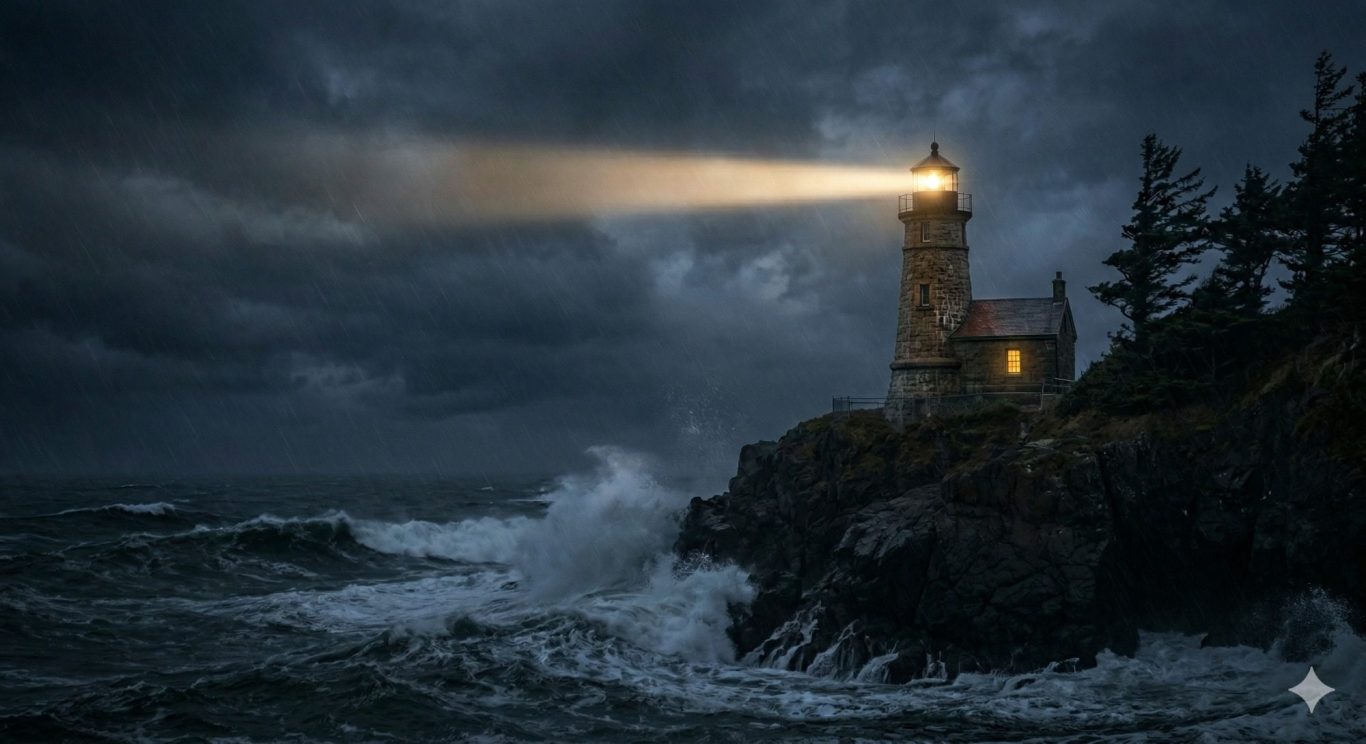
Ultimately, the legacy of John and Abigail Adams teaches us that true resilience is not found in the frequency of communication, but in the structural integrity of the covenant. For those currently navigating their own high-pressure gales, the path forward requires a shared Fudōshin, an unshakeable heart that refuses to be moved by the silence of the storm. When the 'Good Work' feels like a chain, it is the certainty of a steady harbor that sustains the warrior’s spirit. In this sacred vigil, the determination to return is the fuel, but the stalwart heart is the engine. The light of the Pole Star does not flicker. The lighthouse remains lit. It simply remains constant, certain, and immovable welcoming the Warrior’s final return.
April 2, 2026