Lincoln's PGD
Lincoln's PGD
A civil servant carrying grief
Abraham Lincoln is often remembered as the Man of Sorrows, a title earned not only through the weight of the American Civil War but through a lifelong struggle with profound personal loss. For a man who led a nation through its most fractured era, his private life was equally marked by fragmentation. Lincoln and his wife, Mary Todd Lincoln, lost three of their four sons, Eddie, Willie, and Tad, before they reached adulthood. These losses triggered what modern clinicians would identify as Prolonged Grief Disorder, a condition that deeply colored Lincoln’s presidency, his leadership style, and his ultimate legacy.
The distinction between a typical mourning process and the debilitating state of chronic sorrow is often found in how an individual integrates their pain into their daily existence. For Lincoln, this integration was a constant battle between the fossilization of grief, where the pain becomes a rigid and paralyzing monument, and adaptive compartmentalization, where the pain is partitioned to allow for continued service to a higher cause.
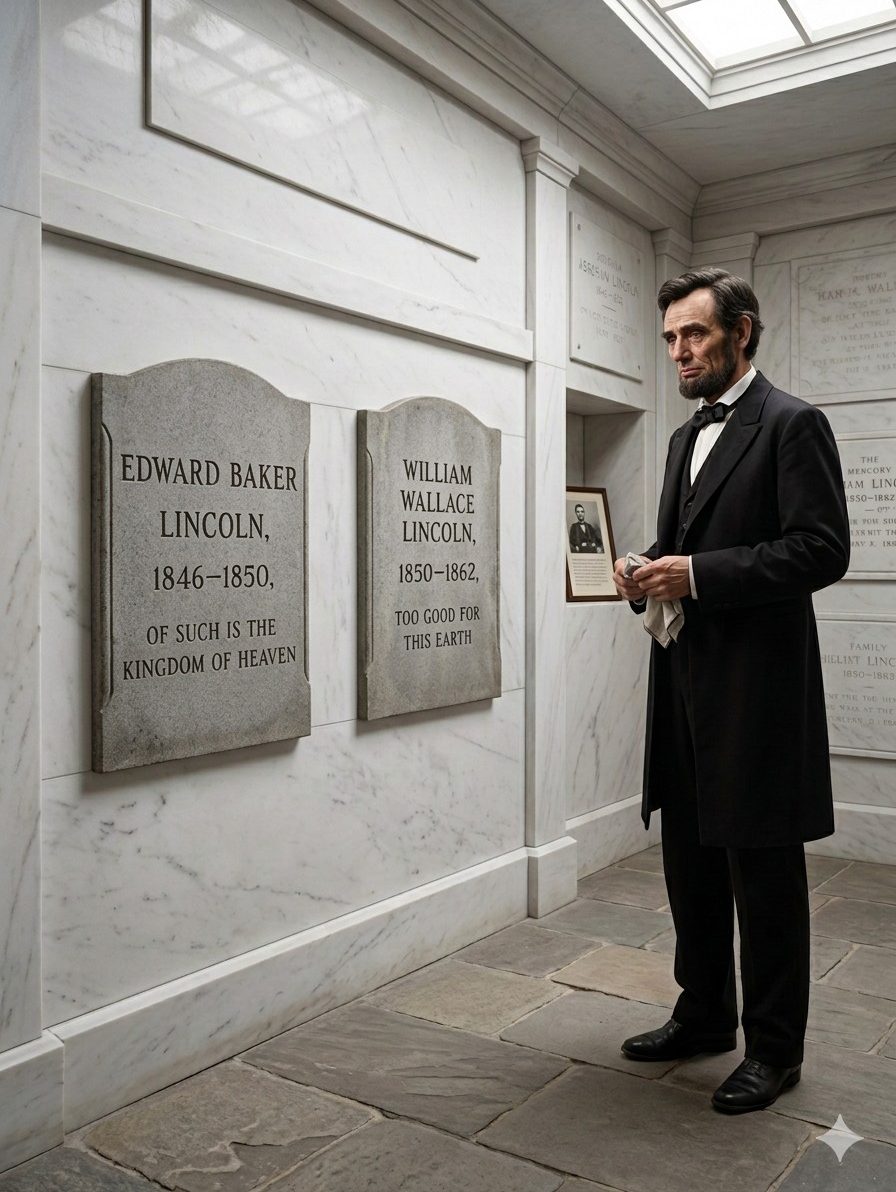
The sequence of tragedy began long before the family reached the White House. In 1850, their second son, Edward Baker Lincoln, died at nearly 4 years old after a fifty-two-day battle with tuberculosis. While Mary Lincoln’s grief was vocal and visible, Abraham’s was quiet and internal, a tenderhearted sorrow that close friends noted changed his demeanor forever.
The most catastrophic blow came in February 1862, when eleven-year-old William Wallace Lincoln died of typhoid fever in the White House. Willie was considered Lincoln’s favorite, the child most like him in temperament and intellect. Upon seeing the body, Lincoln whispered that his poor boy was “too good for this earth” and that it was hard to have him die. This loss was public, occurring while the Civil War raged, forcing Lincoln to balance a father's agony with a commander in chief’s duty. Thomas Tad Lincoln, the youngest, survived his father (who died on Good Friday, April 14, 1865) but died at age 18 in 1871. Only Robert Todd Lincoln lived to old age, leaving a legacy of a family defined by absence.
While the term Prolonged Grief Disorder (PGD) did not exist in the nineteenth century, Lincoln’s symptoms align closely with the diagnostic criteria: intense longing for the deceased; emotional numbness; and a grief that interferes with daily functioning for over a year. Following the death of Willie, his grief was described as “unnerving.” Lincoln reportedly locked himself in his office every Thursday, the day the boy died, to weep in private. Lincoln’s persistent melancholy, compounded by a history of clinical depression dating back to his twenties, suggests that his grief was not a fleeting state but a chronic, disabling condition that the president managed with immense effort.
The impact of this grief on his civil service and leadership was paradoxical. It did not paralyze his presidency but instead transformed it. His personal suffering deepened his capacity for empathy, which became a cornerstone of his political strategy. Just two weeks after the funeral, Lincoln returned to the heavy machinery of war, recommending a program for compensated emancipation and relieving General George McClellan of his command.
Lincoln did not have the luxury of rest. Some historians suggest that the proximity of the death to the issuance of the Emancipation Proclamation is no coincidence. His grief led him to reflect more deeply on divine will and the ways of God, moving him toward a more resolute moral stance on slavery. His openness about his affliction allowed him to connect with a nation also in mourning. He wrote famous letters of condolence, advising others that while perfect relief is not possible except with time, their grief would feel lighter in time.
Lincoln’s profound empathy was perhaps best captured in his written correspondence to those experiencing similar tragedies. In a letter written in December 1862 to Fanny McCullough, the daughter of a close friend killed in the Civil War, Lincoln offered a rare glimpse into his own internal process of moving forward. He wrote that he had "experience enough to know what I say" and urged the young woman to believe that she was sure to be happy again. This specific phrasing highlights how he used his own history with prolonged grief as a tool for connection rather than isolation.
This internal state was deeply apparent to those in his inner circle, such as his friend and bodyguard Ward Hill Lamon. In his memoirs, Lamon provided a striking description of the President’s physical and emotional presence, detailing a man who appeared to be a "sad, weary-looking man" who struck observers as being "at once miserable and kind." These accounts illustrate how Lincoln’s public service was inextricably linked to a private, chronic sorrow that he managed with a unique blend of vulnerability and iron-willed duty.
Lincoln’s primary coping mechanisms were primarily adaptive, representing a form of healthy compartmentalization. He found solace in immersive work, using the demands of the war as a distraction from his internal pain. He famously said he had experience enough to know what he said regarding the necessity of moving forward. He also poured his remaining affection into Tad, often letting the boy play in his office while he worked on war maps. He used storytelling and jokes to whittle down his sadness, viewing laughter as a vital release valve for his melancholy. While never formally joining a church, his grief drove him toward a more religious outlook. He sought comfort in the idea that his children were better off in heaven.
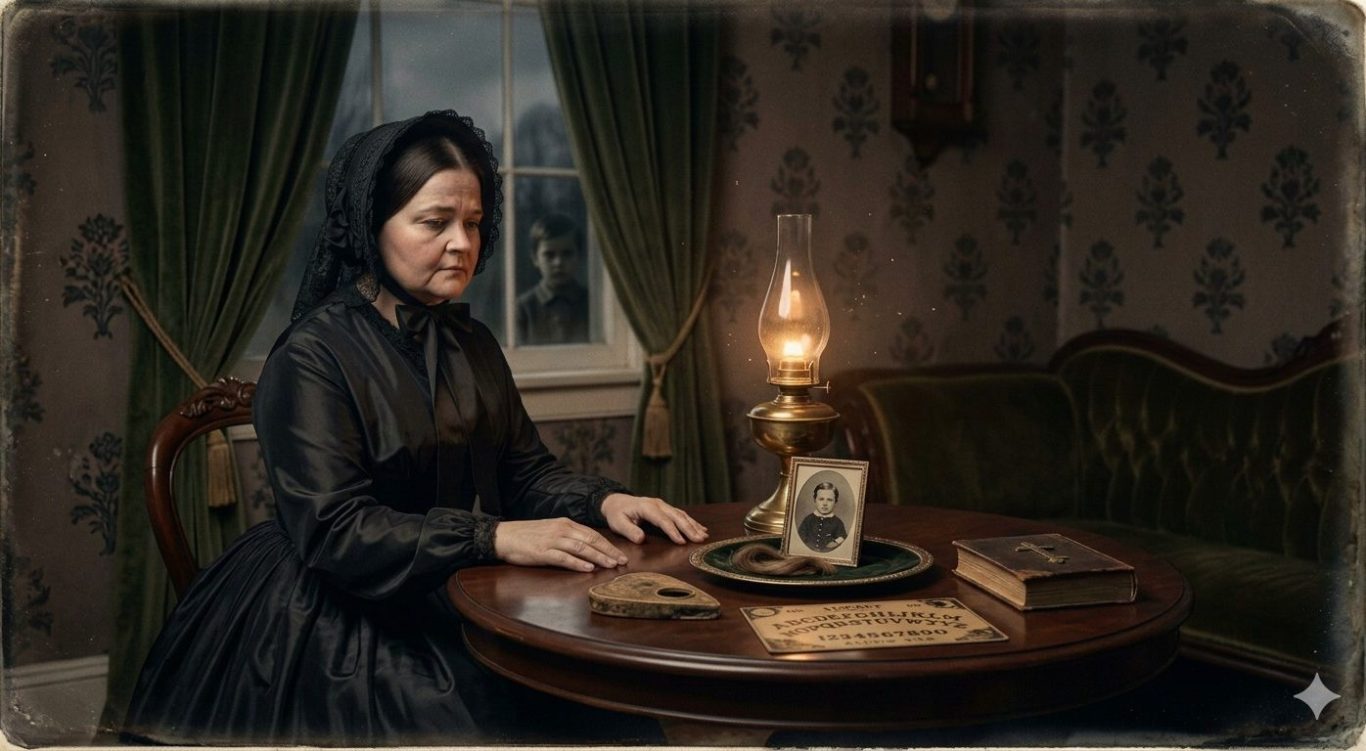
There is a vital difference between the fossilization of grief and the healthy use of compartmentalization. Fossilization occurs when an individual becomes trapped in the past, allowing the loss to define their entire identity and halt their personal growth. This is often seen in the later life of Mary Todd Lincoln. Mary Todd Lincoln’s grief became a rigid, unchanging state that completely stalled her ability to move forward or find meaning in life. Unlike her husband’s adaptive compartmentalization, her behaviors included wearing deep mourning black for the rest of her life, holding frequent séances to communicate with her dead sons, and suffering from a debilitating obsession with her losses that eventually led to her temporary institutionalization. This type of grief is considered dysfunctional because the pain did not evolve over time. Instead, it hardened into a permanent identity that isolated her from the present and consumed her mental health.
Abraham Lincoln practiced a form of functional partitioning. He allowed himself scheduled times to feel the full weight of his sorrow, such as his Thursday retreats, but he did not allow that sorrow to dictate his strategic decisions or his duty to the Union. This was not a denial of pain but a sophisticated management of it. By placing his grief in a temporary compartment, he preserved his cognitive resources for the monumental task of preserving the nation.
This psychological resilience allowed him to turn private pain into public grace. His personal losses made him more hesitant to send young men to their deaths, leading to his reputation for frequent military pardons. He often referred to soldiers as some mother's son, reflecting a raw understanding of the parental bond. His grief shifted his focus from a purely political war to a moral crusade, culminating in the Second Inaugural Address, which reads more like a sermon on shared suffering than a political speech. Lincoln spoke of the need to bind up the nation's wounds because he was intimately familiar with the slow, agonizing process of trying to bind up his own.
Lincoln serves as one of the ultimate case studies on high achievers who live with Prolonged Grief Disorder. He demonstrated oscillation by alternating between periods of intense, private mourning for his sons and periods of high-functioning leadership during the Civil War. This rhythmic movement between the loss-oriented state of his Thursday rituals and the restoration-oriented state of his presidential duties allowed him to process his profound grief without being entirely consumed by it.
Lincoln proves that a person can suffer from a debilitating grief disorder and still perform at the highest level of human achievement. Grief does not go away but instead becomes a part of the person's identity and can actually enhance their emotional intelligence. On his final day, he told Mary that they must both be more cheerful in the future because between the war and the loss of their darling Willie, they had been very miserable. Though his life was cut short, his ability to lead through the fog of grief remains a primary example of resilience in the face of insurmountable loss.